The Deepsoft MPRG 2024
The Ecologies Project: How Climate Changes Culture MPRG 8 December 2024 - 16 March 2025
curated by Dunja Rmandić
The Ecologies Project looked at the effects climate change has had on deep time of human culture. With First Nations voices and continuing calls for the importance of sustainability, this show asked: how does a changing ecology change our culture?
Ten thousand years ago the Mornington Peninsula did not exist. The Bunurong / BoonWurrung people were People of the River not People of the Sea and their traditional lands extended to what is now the top of the north-west/central Tasmania. Climate changes culture. The current climate calamity differs from previous mega-changes in that it has come from us; our colonial, extractionist and capitalist culture has changed the climate.
The exhibition looked at generational conversations about climate, what the changes might look and feel like and what we are creating now that will make it into a wider cultural milieu. With over 60 works, including photographs, painting, prints, installation, video and sound work, the exhibition features artists Maree Clarke, Aunty Netty Shaw, Megan Cope, Sue Ford, Jill Orr, Rosemary Laing, Linda Tegg, Joseph Beuys, Jacobus Capone, Nicholas Mangan, Yandell Walton, Vera Möller, Siri Hayes, and others.
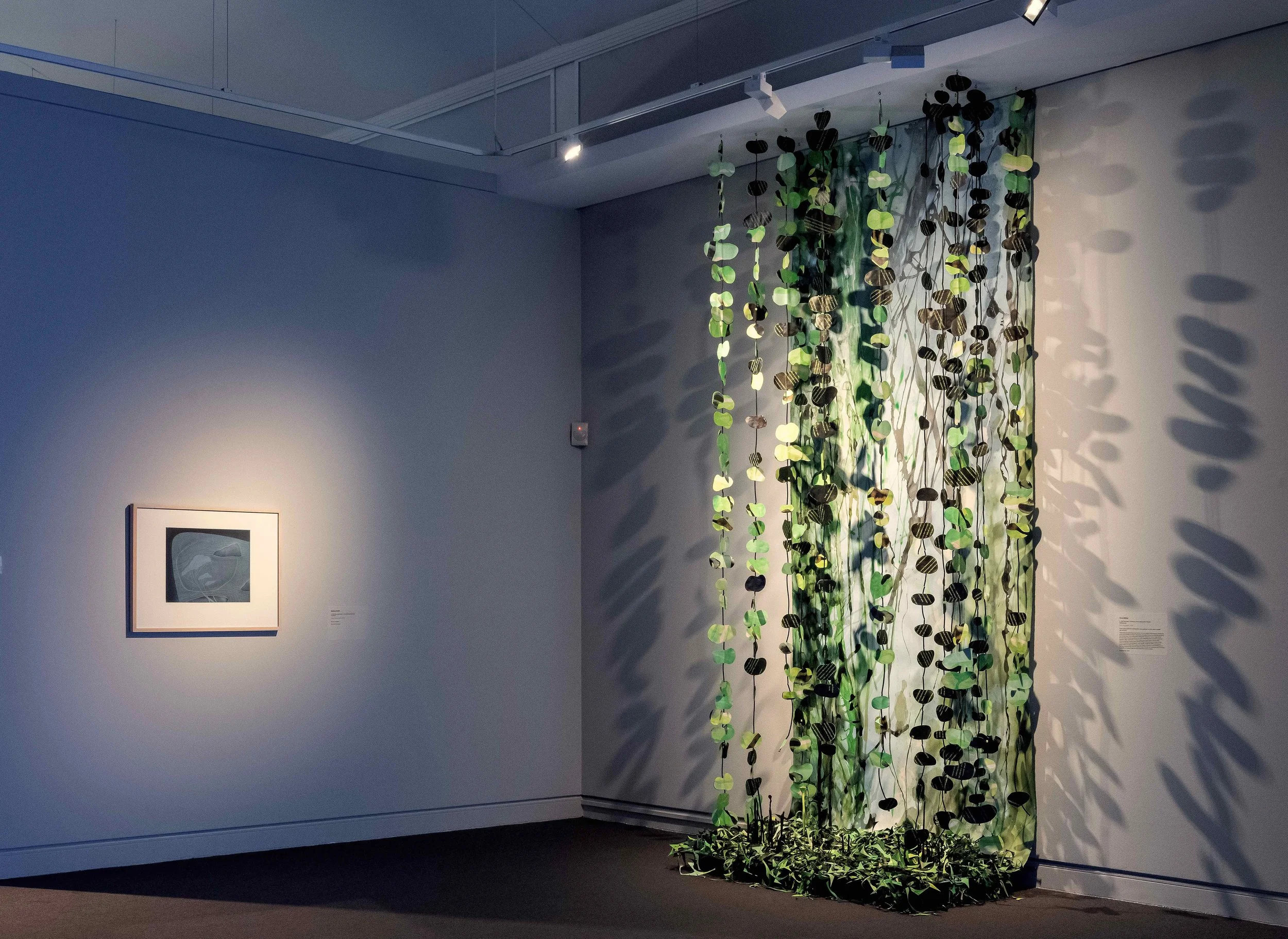
The Deepsoft 2024 Paper, polyvinyl tube, fishing line, ink, pigment, acrylic paint, modeling material H 370 x W 152 x D 91 cm Image courtesy and © the artist
The Deepsoft
The towering, swaying Kelp Forests of temperate and cold waters are anchored to the seafloor and stretch up towards the light. Forming networks of swaying brown macroalgae, they are recognized as one of the most productive and dynamic ecosystems on this planet.
Kelp, like a plant, is photosynthetic and has structures that look like roots (the kelp holdfast), stems (the stipe) and leaves (blades). However, kelp and other algae belong to a separate kingdom of life from plants, called protists.
Spatially and visually these zones resist definition, they remain elusive. They have frequently been described by divers as otherworldly, to have a dreamlike, hallucinatory quality.
Kelp Forest spaces are in constant motion and form shelter for a plethora of diverse species. They are the realm of marine invertebrates (for example the sea urchin and the octopus) and a multitude of fish species.
Giant Kelp Forests (Macrocystis pyrifera) once were abundant along the Victorian Coast but have now largely disappeared. They are in dramatic decline in Tasmania, Western Australia, and elsewhere. A scientific and communal global effort is underway to attempt to turn this around.
"I can only compare these great aquatic forests ... with the terrestrial ones in the intertropical regions. Yet if in any country a forest was destroyed, I do not believe nearly so many species of animals would perish as would here, from the destruction of kelp. Amidst the leaves of this plant [sic] numerous species of fish live, which nowhere else could find food or shelter; with their destruction the many cormorants and other fishing birds, the otters, seals and porpoise, would soon perish also; and lastly, the Fuegian[s] ... would ... decrease in numbers and perhaps cease to exist.
Charles Darwin, 1 June 1834, Tierra del Fuego, Chile
I like to think of these spaces as the ‘Deepsoft’.
Vera Möller 2024